Major Covenants between God and Humans Beings in the Bible
Definition of "COVENANT": a formal agreement, contract,
testament, or treaty between two parties, with specific obligations on each side:
ancient terminology: Hebrew berith, Greek diatheke,
Latin testamentum
used 287 times in the Hebrew Bible (first use at Gen 6:18), including "Baal-berith" in Judges 8:33 & 9:4, and "El-berith" in Judges 9:46.
used 33 times in the New Testament, especially in the Letter to the Hebrews (17 times).
covenants often promise specific benefits, rewards, or blessings for people who keep the terms of the covenant;
but they also threaten sanctions, punishments, or curses for people who break the terms of the covenant.
covenants need to be ratified formally, usually sealed with blood, and thus often involve animal sacrifices;
concrete symbols or "signs" are also often exchanged to remind the two parties about their agreement.
the parties involved might be individuals, families, states, kings, or even God;
the parties might be on the same level (two families, two kings) with mutual obligations agreed upon freely
or they might be on different levels (God and humans; a large empire and a smaller nation) with the stronger party imposing the conditions on the weaker party (obedience, taxes, tribute) in exchange for certain benefits protection)
some scholars distinguish between "contract" (an exchange of goods and services) and "covenant" (an exchange of persons; for example in a marriage, or when Israel is called God's "firstborn son" in Exod 4:22)
Main Covenants in the Hebrew Bible: the first two apply to all human beings, the next three apply specifically to the Jews, the "Children of Abraham":
ADAM and Eve (Gen 1-2; although the word "covenant" is not used, some divine promises are made)
Life on Earth: "Be fruitful and multiply; fill the earth and subdue it..." (1:28)
Vegetarian Diet: "I have given you every plant... and every tree with seed in its fruit... for food" (1:29)
Male and Female: "It is not good that the man should be alone" (2:18; cf. 1:27)
Disobedience and Death: "...but of the tree of the knowledge of good and evil you shall not eat" (2:17)
NOAH and his Family (Gen 6-9)
Life: God saves the family of Noah (6:18), telling them to be fruitful and multiply, and fill the earth (9:1, 7)
Diet: they may now also eat animals, but may not eat/drink their blood, and may not shed human blood (9:2-6)
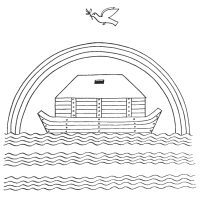
Covenant: God promises not to destroy the whole human race again through a flood (9:8-11)
the "sign" of this covenant: the rainbow set in the clouds each time it rains (9:12-17)
ABRAHAM and his Descendants (Gen 12, 15, 17)
his descendants will be numerous and will become a great nation (12:2; 15:5; 17:20; 18:18; etc.)
they will inherit the "promised land," later called the land of Israel (12:1; 15:18-21; 17:8; etc.)
all other nations shall be blessed in him (12:3; 18:18) or through his offspring (22:18; 26:4)
the "sign" of this covenant: the circumcision of all male descendants (17:9-14, 23-27; 21:4; etc.)
MOSES and the Israelites (Exod 20-34; Deut 5-11)
Monotheism: "Hear, O Israel: The Lord is our God, the Lord alone" (Deut 6:4; cf. Exod 20:1-3)
Torah: the Law given on Mount Sinai, or Mount Horeb (esp. the Ten Commandments: Exod 20:1-17; Deut 5:1-21)
Reciprocity of relationship: "I will be your God, you will be my people" (esp. Exod 6:7; Lev 26:12)
the "sign" of this covenant: the stone tablets on which the Law is written (Exod 24:12; 31:18; etc.)
DAVID and the Kingdom (2 Sam 7)
God will establish forever David's "house" = the royal dynasty through his descendants (7:11-16)
David's son (Solomon) will build God's "house" = the first temple of Jerusalem (7:4-7, 13)
the "sign" of this covenant: the descendants of David (1Kings 1-3) and the temple itself (1Kings 5-8)
The "New" or "Renewed" Covenant:
JEREMIAH
The Lord will make "a new covenant with the house of Israel and the house of Judah" (Jer 31:31)
God's Law will be within people, written on their hearts (Jer 31:34)
This text is also quoted in the New Testament in Heb 8:8-12
JESUS
At the Last Supper: "This cup that is poured out for you is the new covenant in my blood." (Luke 22:20; cf. 1 Cor 11:25)
The Letter to the Hebrews calls Jesus "the mediator of the new covenant" (Heb 9:15; 12:24; see also 8:1-13)
Paul also speaks of Christian leaders as "ministers of a new covenant" (2 Cor 3:6)
Seven Main "Pillars" of Ancient Judaism:
[related to the covenants with Abraham, Moses, and David--as listed above]
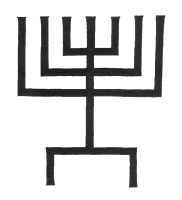
Election: the people of Israel are "chosen" by God; they are to be "holy" (="set apart"; different from other nations)
Land: the "Holy Land" was "promised" by God to be theirs forever; a "land flowing with milk and honey"
Monotheism: there is only One God = YHWH; cf. the "Shema" prayer (Deut 6:4) - [cf. earlier stage: Henotheism]
Law: core in "Decalogue" (10 Commandments); also the whole "Torah" (Five Books of Moses) & the whole Bible
Monarchy: the Davidic dynasty ("House of David"; "Sons of David") should reign as kings over Israel forever
Temple: the "House of God" should be in Jerusalem, so that God can dwell in the midst of his people
Messiah: when the covenants are broken, God will raise up an "anointed" leader to restore the nation to God,
and to restore the earth to peace and justice with no more war, disease, death, etc. (exact expectations vary)
Progression of Theologies in Ancient Judaism:
Deuteronomistic Theology (dominant in the Torah, esp. the Book of Deuteronomy):
The Decalogue (Ten Commandments):
Exodus 20 (but see all of ch. 19-24 and 32-34 for the context)
Deuteronomy 5 (but see also 27-30 for the related blessings and curses)
Consequences of One's Actions:
Obey the Lord, and you will be blessed/rewarded (during your life here on earth)
Disobey the Lord, and you will be cursed/punished (during your life here on earth)
Effects on Future Generations:
Punishments down to the third or fourth generation of descendants
Rewards down to the thousandth generation of descendants (cf. Exod 34:6-7; Deut 5:9-10)
Prophetic Theology (found throughout most of the books of the Hebrew Prophets):
Prosperity in the Present:
If things are going well, don't take it for granted, neglect God or abuse the poor (Isa 5:1-13; Amos 8:4-6).
Prophets warn the people not to be evil or complacent, but to do God's justice (Amos 5:24; Micah 6:1-8).
Difficulties in the Present:
If life is going badly, God must be punishing you for your sins and transgressions (Ezek 7:1-4; Amos 2:4-16).
Prophets admonish the people to repent, trust in God, and find comfort in their sufferings (Hos 14:1-4; Joel 2:12-27).
Conditional "Prophecies" about the Future :
If you repent and turn back to God, your punishment will end and your life will be saved (Isa 40:1-11; Jer 3:12-14).
If you ignore God's warnings and refuse to repent, your punishments will lead to disaster (Isa 3:1-26; Micah 3:1-12).
Apocalyptic Theology (new in the Books of Daniel and Revelation, and in post-biblical Jewish literature):
Reversal of Rewards and Punishments:
present world is still under the domination of evil forces and cruel empires (Dan 7:1-8, 15-25), but...
future age will be under the rule of God, the Messiah, and/or God's holy people (7:9-14, 26-27).
Good People:
may be suffering now, due to evil cosmic forces; seem to be punished here on earth (Dan 9:3-14), but...
will be rewarded at the end of time, when God comes in judgment and vindicates the righteous (12:1-13).
Bad People:
may be prospering now, due to worldly powers; seem to be rewarded on earth (Dan 5:1-23; 8:1-25a), but...
will be punished at the end of time, when God comes in judgment and destroys all evil (5:24-30; 8:25b-26).
 Election: the people of Israel are "chosen" by God; they are to be "holy" (="set apart"; different from other nations)